When are student finance payment dates?
If Student Finance England funds you, your Maintenance Loan arrives in three payments, one at the start of each term. The first one is released only after you’ve registered at your university. Try our free student budget calculator to spread each instalment across the months and weeks it has to last.
The short answer
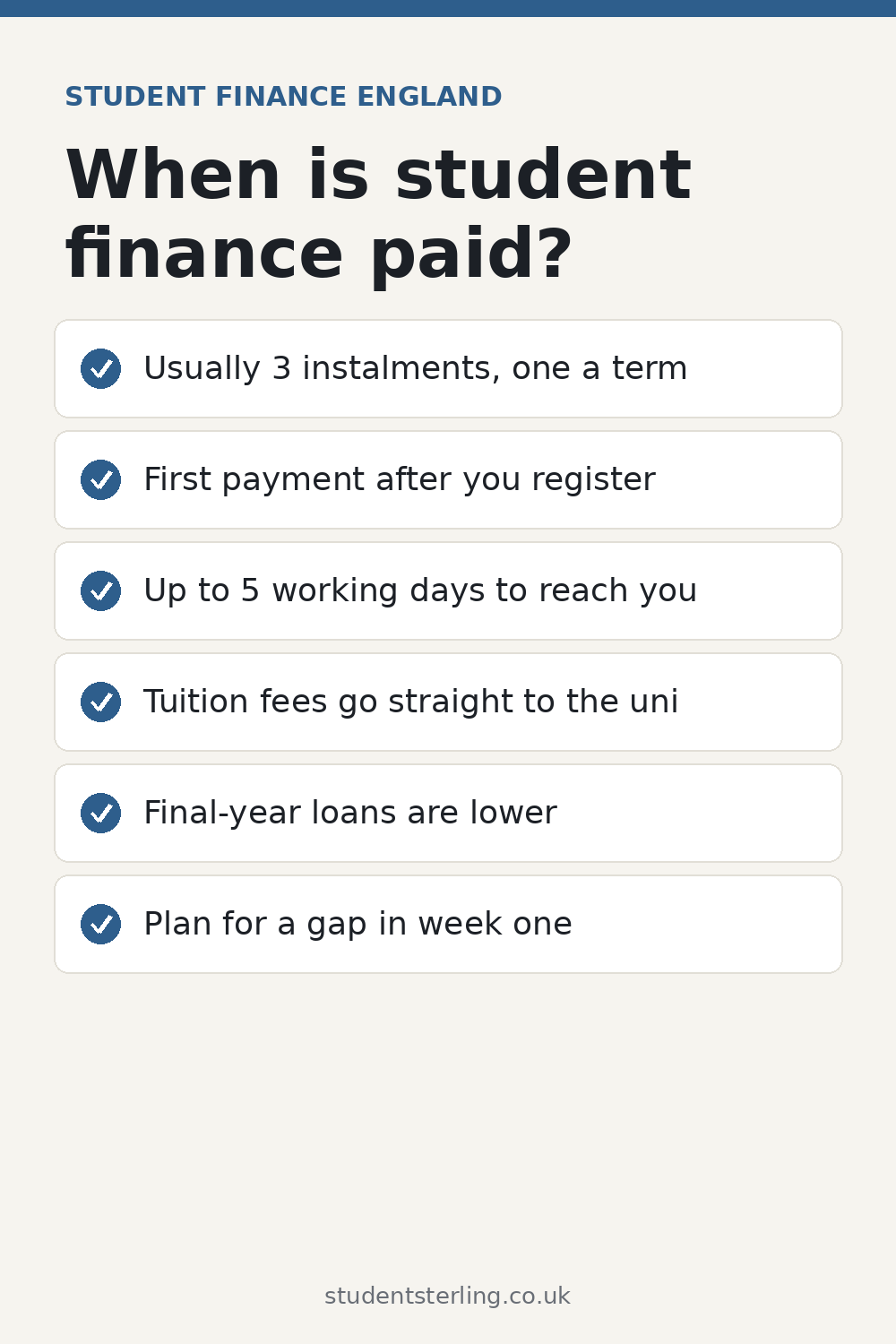
Usually in 3 instalments, normally at the start of each term. The first comes after you register at your university or college, usually in your first week. It can take up to 5 working days to reach your account.
Checked 12 November 2026 against the official pages named in each section.
- Instalments
- 3, normally at the start of each term
- First payment
- After you register, usually in week one
- Time to reach your bank
- Up to 5 working days
- Tuition Fee Loan
- Paid straight to your university or college
- Latest you can apply
- Up to 9 months after the academic year starts
- Confirmed place needed to apply?
- No
When does the money arrive?
“You’ll usually be paid in 3 instalments, normally at the start of each term.” The exact dates depend on your university’s term dates, so there’s no single national payment date.
Payment late? What to do if your student finance hasn’t arrived.
- Fees don’t come to you. “Tuition Fee Loans are paid directly to your university or college. Maintenance Loans are paid into your bank account.”
- Final year is lower. “You’ll get less money in your final year because SLC stops paying you after the last day of term.”
- Part-time students are paid “2 weeks after the start of each term”.
Sources, checked 12 November 2026: Student finance: how you’re assessed and paid 2026 to 2027 (GOV.UK); Student finance for new full-time students (GOV.UK); Student finance for part-time students (GOV.UK).
What do I need to do before the first payment?
Give Student Finance England your bank details and register at your university. The order looks like this:
No account yet? Compare student bank accounts.
- Open a UK account in your name“Open a UK bank or building society account in your name and give us your account details before the start of term.”
- Register at your university or college“You need to register at your university or college before we can make your first payment. You’ll usually do this in the first week of your course.”
- Allow a few days“It can take up to 5 working days for your money to reach your account, depending on your bank.”
Sources, checked 12 November 2026: Student finance: how you’re assessed and paid 2026 to 2027 (GOV.UK); Student finance for new full-time students (GOV.UK); Student finance for part-time students (GOV.UK).
When is the January 2027 payment?
For most courses that started in the autumn, the January payment is the second of the three usual instalments. “You’ll usually be paid in 3 instalments, normally at the start of each term.”
The exact date is set from your university’s term dates. There is no single national payment date, and Student Sterling does not publish a day the official sources do not give.
If your course starts on or after 1 January 2027, the payment pattern is different: the first payment comes once your provider confirms you have registered, and later payments may be in January, April, July or September. See the section below and student finance from 2027.
How late can I apply?
Up to 9 months after the first day of the academic year for your course. The exact date depends on when your course starts.
For example, a course starting in September falls between 1 August and 31 December. So the latest you can apply is 31 May after your course started.
“You do not need a confirmed place to apply.”
| Course start date | Apply by |
|---|---|
| Between 1 August and 31 December | 31 May after your course started |
| Between 1 January and 31 March | 30 September after your course started |
| Between 1 April and 30 June | 31 December after your course started |
| Between 1 July and 31 July | 31 March after your course started |
Source, checked 12 November 2026: Apply for student finance: when to apply (GOV.UK).
Whose income decides how much I get?
Your household’s income. For the 2026 to 2027 academic year, Student Finance England usually looks at household income for the tax year 2024 to 2025.
If your parents’ household income has dropped by 15% or more, they can ask for this year’s likely income to be used instead.
If parents don’t give their income details, “you will not get the full amount of Maintenance Loan available”. The maintenance loan estimator shows how income changes the amount.
Sources, checked 12 November 2026: Student finance: how you’re assessed and paid 2026 to 2027 (GOV.UK); Apply for student finance: when to apply (GOV.UK).
Is it different if my course starts in 2027?
Yes, for courses starting on or after 1 January 2027. These use a different application route.
The first Maintenance Loan payment comes “once your education provider has confirmed to Student Finance England that you’ve registered for the course”.
After that, “you may receive up to 2 more payments a year in January, April, July or September, depending on when the course started and how long it is”. More on student finance from 2027.
Sources, checked 12 November 2026: Student finance from 1 January 2027: how you’ll be paid (GOV.UK); Apply for student finance: when to apply (GOV.UK).
I’m from Scotland, Wales or Northern Ireland. Does this apply?
No. This page covers Student Finance England. The other funding bodies set out their payment arrangements on their own sites, linked from funding you can get.
Common questions
When are student loan payment dates?
If Student Finance England funds you, the Maintenance Loan is usually paid in three instalments, normally at the start of each term. There is no single national payment date: the dates follow your university’s term dates. The first instalment is released after you register, and can take up to five working days to reach your account.
What are the maintenance loan dates for 2026/27?
There is no single national date. If Student Finance England funds you, the Maintenance Loan is usually paid in 3 instalments, normally at the start of each term, so the dates follow your university’s term dates. For a course that started in the autumn, the January payment is the second of the three. The first is released after you register and can take up to 5 working days to reach your account.
What does the student finance payment calendar look like?
For most full-time courses that start in the autumn: the first instalment at the start of the first term, after you register; the second at the start of the January term; and the third at the start of the final term. Part-time students are paid 2 weeks after the start of each term. Courses starting on or after 1 January 2027 follow a different pattern, set out on this page.
When is the first student loan payment made?
For students funded by Student Finance England, normally at the start of the first term, after you have registered at your university. GOV.UK says it can take up to 5 working days to reach your account.
How many times a year is the Maintenance Loan paid?
Usually in 3 instalments, normally at the start of each term.
Can I apply for student finance after my course has started?
Yes. GOV.UK says you can apply up to 9 months after the first day of the academic year for your course. You might get less money than expected if you apply late.
Are tuition fee loans paid into my bank account?
No. GOV.UK says tuition fee loans are paid directly to your university or college. Maintenance Loans are paid into your bank account.
Do I get less money in my final year?
Yes, if you are funded by Student Finance England. GOV.UK says you get less money in your final year because SLC stops paying you after the last day of term.
More money essentials (24)